CTXDEX: Building a Synthetic AI Universe to Understand the Real One
AI Models · Knowledge Systems · Pricing · Scenario Economics · Product Design
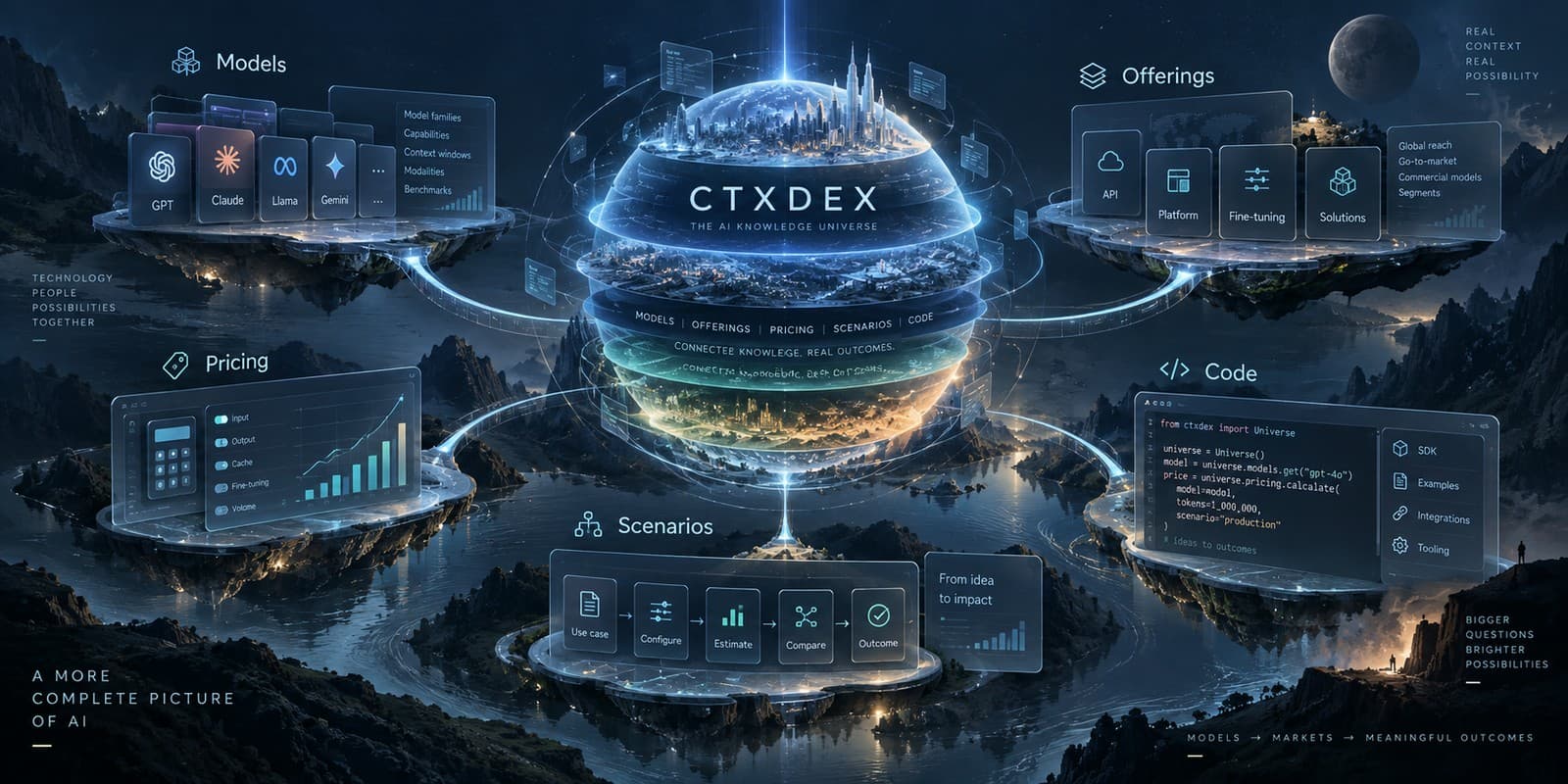
CTXDEX started from a fairly simple idea. I wanted to build something like the model-catalogue sites already out there — a place to explore AI models, understand what they do, compare them, and look at pricing.
But once I started going deeper, I realised I wanted more than a catalogue. Why not create a synthetic AI universe instead — one where I could model every aspect properly, introduce new concepts deliberately, and keep evolving it as the industry changes?
That became CTXDEX.
More than a list of models
The current universe has 94 synthetic models spanning language, reasoning, coding, embeddings, image, video, audio, document intelligence, robotics and scientific domains. Around them sit families, brands, snapshots, capabilities, tasks, modalities, lifecycle, licences, distributions, serving information and commercial offerings.
What interested me was how all of those pieces connect. A model is not the same thing as the way it is commercially offered. An offering is not the same thing as a price. A workload is not the same thing as a complete solution. Keeping those distinctions explicit became one of the core design ideas in CTXDEX.
The synthetic choice turned out to be quite liberating. I did not have to limit the system to whatever combination of models, providers, prices or product structures happened to exist publicly at one moment. I could build a realistic universe and use it to explore the ideas themselves.
Pricing became its own system
Once the commercial layer became richer, pricing naturally became much more than input and output tokens. CTXDEX can represent cached input, images, video, audio, document pages, embeddings, searches, capacity, commitments, routes, tiers, allowances and different pricing mechanisms over time.
That led to a deterministic pricing engine and workload calculator. The important part for me is not only getting a number. The system should also explain how that number was reached, what assumptions were used, and what remains unresolved.
Then came solution economics
A real AI-enabled solution is rarely one model call. It may use several models, retrieval, search, tools and deterministic processing. So CTXDEX now has a scenario-economics layer that breaks a Reference Solution into operations and reusable activities and prices them through the same underlying engine.
The current Enterprise Document Processing example compares Standard and High Accuracy designs at both unit and volume level. What I found more interesting than the numbers was that the second solution could largely be added through reusable definitions and declarative structure, without changing the pricing engine or canonical pricing data.
And then CTXDEX Code
There is also a parallel experiment called CTXDEX Code, where I am applying the same structured-catalogue thinking to a synthetic coding-agent product — its features, commands, arguments, syntax, examples, relationships and model support.
For me, that starts testing whether the same approach can extend beyond model catalogues into broader structured product knowledge.
A knowledge site — for others and for myself
That is probably the simplest way I think about CTXDEX now. It is a public knowledge site for exploring AI models, commercial structures, pricing, solution economics and related concepts. But it is also a personal laboratory.
Because the core universe is synthetic, I can keep introducing new model types, pricing ideas, serving approaches and product concepts as the industry evolves — while still keeping the whole system internally understandable and explainable.
Where it is now
V1 is built and publicly accessible at ctxdex.com. The synthetic model universe, commercial and pricing knowledge, deterministic pricing engine, scenario-economics flow and CTXDEX Code catalogue are all implemented to meaningful depth.
Enhancements are continuing across the catalogue, calculator, comparison, scenario library and knowledge experiences. What keeps me interested is that CTXDEX is gradually becoming a place where the technical, commercial and solution-level structure of AI can be explored together — not just listed separately.
The synthetic universe gives me room to keep learning from the industry as it changes, while building a system deep enough to explain the ideas rather than simply display them.